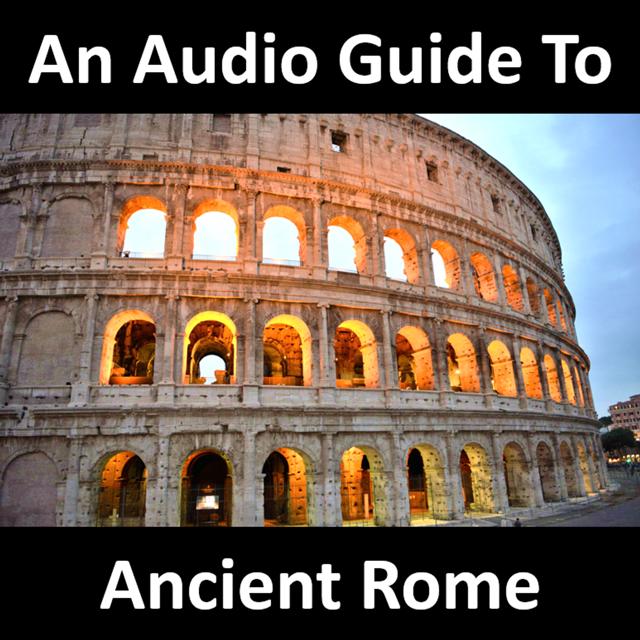
A free audio guide that helps you discover the history and context of Rome's ancient sites.
Go to www.rome-podcast.com for an interactive map of the locations covered and full transcripts of the episodes.
Each episode focuses on a specific historical site and guides you through a short tour with the goal of providing a concise but insightful summary of the history and context.
Hope you find this informative and useful. Enjoy your time in Rome!
Daron
Disclaimer:
I have endeavored to check all the information presented against the latest known interpretations of the archaeological evidence. Please feel free to provide feedback or corrections if you note something is wrong or has changed since the time of recording.
Acknowledgement:
This podcast builds on the extensive notes, information and pictures recorded by Jeff Bondono (see www.JeffBondono.com). Jeff kindly gave permission for me to use his site for reference materials. I encourage you to explore the comprehensive pictures he has created to record all the sites covered in this series (and many more). You will also see that Jeff's work (and therefore this podcast) builds on the prior notes and walking tours created by Walter Muzzy.
📻 Siste episoder av An Audio Guide to Ancient Rome
Her er de nyeste episodene tilgjengelige via RSS-feeden:
Laster episoder...
📱 Slik abonnerer du på An Audio Guide to Ancient Rome
Trajan’s Column is a monument to Emperor Trajan’s victory in the wars with Dacia that took place between the years 101 and 106. It was part of a sequence of constructions built by or dedicated to Tra...
35: The Column of Marcus Aurelius (00:11:09)
This monument celebrates Marcus Aurelius’ two successful military campaigns against tribes north of the Danube in what is modern day Germany. The first campaign ran from the year 172-173 and was wage...
34: The Mausoleum of Augustus (00:10:08)
Augustus started building the mausoleum following his victory over Anthony and Cleopatra in 31 BCE at the naval battle on the west coast of Greece close to the promontory of Actium – his success broug...
33: The Theater of Marcellus (00:10:12)
The Theater was named after Emperor Augustus’ nephew Marcus Claudius Marcellus however the building was originally commissioned by Julius Caesar who bought and cleared the land in a space to the south...
32: The Pyramid of Cestius (00:07:51)
The Pyramid of Cestius was built during the reign of the emperor Augustus, probably between 18 and 12 BCE. It’s surface is white Carrara marble and the tip is exactly 100 Roman feet (30 meters) high.
...
12: The Temple of Vesta (00:04:51)
The Temple of Vesta was integrated into the adjacent House and Sanctuary of the Vestal Virgins. The only remains of the temple itself are a modest mound of concrete however there is a reconstruction o...
13: Temple of Divus Romulus (00:05:29)
The Temple of Divus Romulus is recognizable as a tall round building on the North side of the Via Sacra. From the name you can be forgiven for thinking that this temple is dedicated to Romulus the leg...
14: Temple of Antoninus and Faustina (00:05:33)
The Temple of Antoninus and Faustina is easily recognized by the six columns that dominate its front – these are topped by an entablature that carries the dedication to “Divo Antonino et Divae Faustin...
15: The New Basilica (00:06:03)
Construction of the New Basilica began under the emperor Maxentius in the year 308 but was completed by emperor Constantine in 312 after his victory over Maxentius at the Battle of the Milvian Bridge....
16: The Temple of Divine Julius (00:06:23)
Little of the Temple of Divine Julius remains however a lot is known about the events that led to its construction and what it looked like.
Julius Caesar was assassinated on the 15th March in the y...
17: The Temple of Castor and Pollux (00:06:13)
The Temple of Castor and Pollux is readily recognizable by its remaining 3 white columns standing in a line close by the Temple of Vesta. These columns are part of the side of a much later rebuild of...
18: The Basilica Paulli (00:06:02)
Before the Basilica Paulli was built, this location had already served as the site of a basilica commissioned in 179 BCE by consul Marcus Fulvius Nobilior. That building replaced a series of butchers ...
19: Black Stone, Rostra and Phocas (00:08:48)
You’re listening to an Audio Guide to Ancient Rome. This episode is one in a series of short descriptions of monuments in the Roman Forum. In this episode I’m describing the Black Stone, Rostra and ...
20: The Curia Julia (00:05:42)
The Curia Julia is the third building in the Forum that was purpose built as the Senate’s meeting place and each bore the name of its financial sponsor.
The custom of meeting in a Curia was believed...
21: The Arch of Septimius Severus (00:09:03)
The Arch commemorates the victories of Emperor Septimius Severus and his sons, Caracalla and Geta, in the two campaigns waged against the Parthians between the years 194 and 199.
Before this the Roma...
22: The Temple of Concord (00:05:24)
The Temple of Concord is the site of a series of shrines dedicated to the Roman goddess Concordia, and erected at the western end of the Roman Forum. The earliest temple is believed to have been vowed...
23: The Temple of Saturn (00:05:10)
The Temple, repaired and rebuilt over many centuries, is one of the most ancient buildings in the Forum. Its construction was ordered by the last Etruscan King, Tarquin the Proud, in the late 6th or ...
24: The Temple of Vespasian and Titus (00:05:31)
The Temple of Vespasian and Titus sits at the north-west end of the Forum between the Temple of Saturn and the Temple of Concord and backs onto the Tabularium. It is readily identified by the three C...
25: The Basilica Julia (00:04:33)
The Basilica Julia was dedicated by Julius Caesar in 46 BCE – the same year that his nearby Forum was completed. Caesar funded the construction with monies taken during his highly successful campaign...
26: The Forum of Julius Caesar (00:08:14)
This area, at the side of the Capitoline Hill, was the border between two of the ancient tribes and a site for burials roughly 3,000 years ago. Archaeological evidence shows that at times there were a...
27: The Circus Maximus (00:15:42)
Legend has it that the Circus Maximus was founded by the early kings of Rome in the 6th Century BCE. It is undoubtedly the oldest and was by far the largest public sports venue of ancient Rome.
It...
29: Largo Argentina (00:11:21)
Largo Argentina is an exposed cluster of four temples to the south of the Pantheon and east of the Campo De’ Fiori. Today these sit in the middle of a large square and next to a bustling set of road i...
30: The Palatine HIll (00:35:02)
As part of this description I will provide some directions and guidance to specific locations to help you explore the site however it is difficult to provide an exact route as the access paths change ...
31: The Mausoleum of Hadrian (00:08:48)
If you’re looking on a map for Hadrian’s Mausoleum then you may well not locate it as its name, purpose, shape and context has changed radically over the past 1900 years. Today it is more commonly kn...
11: The Temple of Roma and Venus (00:05:20)
The Temple of Roma and Venus was designed and commissioned by the Emperor Hadrian. Building started in the year 121 and this, the largest of Rome’s Temples, was inaugurated in the year 135. The build...
Side 1 av 1
An Audio Guide to Ancient Rome - Gratis RSS Feed for Norsk Podcast | OpenPodMe | OpenPodMe - Åpen RSS for Norske Podcaster