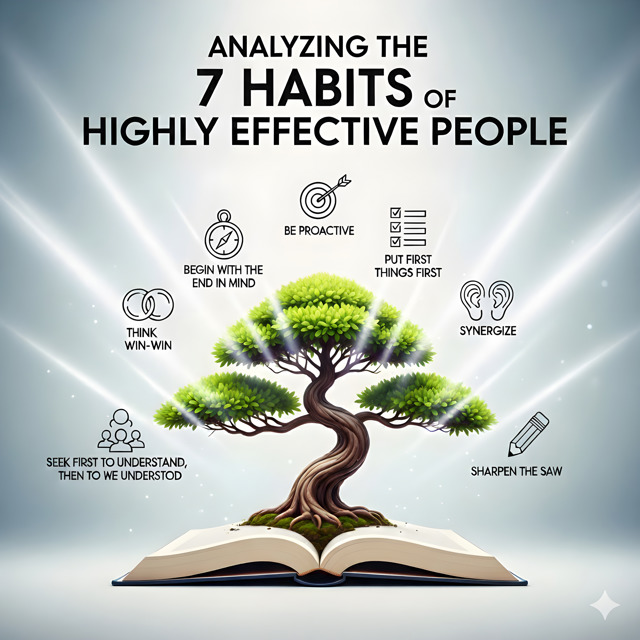
Om Analyzing the 7 habits of highly effective people
In a world of constant distraction and urgent demands, are you focused on what truly matters?Welcome to "Analyzing the 7 Habits of Highly Effective People" a podcast dedicated to exploring Stephen R. Covey’s timeless framework for personal and professional effectiveness.In our foundational first season, we embark on a structured journey to move beyond short-term fixes and build a foundation based on lasting principles. We begin with the "Private Victory," mastering the habits of self-discipline and personal vision. From there, we progress to the "Public Victory," exploring principles of profound communication, creative collaboration, and mutual respect. Finally, we'll learn the secret to sustainability with the habit of renewal.And the journey doesn't stop there. In Season 2 (coming soon), we move from knowing to doing. Each episode is a deep dive into the specific tools and mindsets—like mastering your Circle of Influence or leveraging the Time Management Matrix—that help you apply these principles in the real world. If Season 1 drew the map, Season 2 teaches you how to navigate the terrain.This podcast is not a reading or summary of the original book. Instead, it's our independent analysis and practical guide to adapting these powerful principles for the challenges of the modern world. Whether you're leading a team, managing a project, or simply seeking to live a more fulfilling and effective life, this series offers a framework for creating sustainable, positive momentum. Join us as we decode the operating system for success.Please note: This podcast was conceived, directed and produced by Andreas Sollenbrant. The project began as a personal journey to translate the foundational ideas of Stephen R. Covey's work into a practical framework for today's world. To structure this exploration, all scripts and analyses were generated using AI tools, resulting in this unique and modern deep dive.The podcast does not reproduce or use the original text of The 7 Habits of Highly Effective People. Instead, it builds on the widely known principles through independent analysis, commentary and practical application in a modern world.
📻 Siste episoder av Analyzing the 7 habits of highly effective people
Her er de nyeste episodene tilgjengelige via RSS-feeden:
Laster episoder...
📱 Slik abonnerer du på Analyzing the 7 habits of highly effective people
Season 2, Episode 14: The Habits Unpacked: Your Blueprint for a Life of Sustainable Effectiveness (00:30:09)
In our Season 2 finale, we bring it all together. This episode unpacks the entire 7 Habits framework as a single, cohesive system for a life of purpose and effectiveness. We'll trace the journey from the "inside-out" approach of the Private Victory—mastering yourself first—to the collaborative power of the Public Victory. This is your ultimate recap, designed to solidify your understanding and provide a clear blueprint for how these timeless principles work together to help you build a life of sustainable success and fulfillment.Episode Notes & Key Takeaways:Recap: The Inside-Out Approach: The journey always begins with your inner self—your character, your paradigms, and your motives. Lasting change is an inside job.The Private Victory (Habits 1-3): This is the foundation of self-mastery. Being proactive, beginning with the end in mind, and putting first things first are the habits that allow you to move from dependence to independence.The Public Victory (Habits 4-6): Once you have mastered yourself, you can achieve effective interdependence. This involves thinking win-win, seeking first to understand, and synergizing to create outcomes you couldn't achieve alone.The Engine of It All (Habit 7): Sharpening the saw is the habit of renewal that makes all the other habits sustainable and fuels the upward spiral of growth.Final Challenge: As we conclude the season, the ultimate challenge is to not just know these principles, but to live them. Choose one habit to focus on and consciously practice it, making it a true part of who you are.
Season 2, Episode 13: The Upward Spiral: Beyond the Checklist - Mastering Continuous Growth (00:34:21)
Is personal growth a final destination or a continuous journey? In this powerful episode, we explore the concept of the Upward Spiral. Learn why the 7 Habits are not a one-time checklist but a framework for lifelong improvement. We'll show you how the process of "Learn, Commit, Do," fueled by the habit of self-renewal, allows you to revisit the principles at ever-higher levels of understanding. This is the key to moving beyond simple knowledge and turning the habits into an integrated, powerful force for growth in your life.Episode Notes & Key Takeaways:Beyond the Checklist: The 7 Habits are not a set of tasks to be completed once. They are principles to be revisited and integrated more deeply over time.The Upward Spiral of Growth: This is the process of continuous improvement. By consistently engaging in renewal (Habit 7), you are able to apply the other six habits with greater understanding and effectiveness, creating a positive, upward cycle.The Learn, Commit, Do Cycle: The engine of the upward spiral is a three-step process:Learn: Gaining new knowledge and deepening your understanding of a principle.Commit: Making a conscious decision to apply that learning.Do: Putting the principle into practice through your actions.Neuroplasticity and Growth: The concept of the upward spiral aligns perfectly with our understanding of neuroplasticity—the brain's ability to change and adapt. Consistent practice literally rewires our brains for greater effectiveness.
Season 2, Episode 12: Sharpen Your Saw: The Essential Art of Self-Renewal for Peak Performance (00:44:24)
In a culture that often rewards burnout, are you taking the time to stay sharp? This episode is a practical guide to Habit 7: Sharpen the Saw. We explore why proactive, balanced self-renewal is not a luxury but a fundamental discipline for sustainable success. We break down the four key dimensions of your life that require consistent renewal—physical, mental, spiritual, and social/emotional. Learn how to move beyond feeling "too busy to improve" and start making the small, regular investments in yourself that yield massive long-term returns.Episode Notes & Key Takeaways:The "Sharpen the Saw" Analogy: We revisit the story of the woodcutter who is too busy sawing to sharpen his saw. This illustrates that taking time for renewal actually makes you more effective, not less.Renewal is a Quadrant II Activity: Sharpening the saw is a classic "Important, Not Urgent" task. It requires proactivity and discipline to schedule it into your life consistently.The Four Dimensions of Renewal: A balanced renewal strategy addresses all four aspects of your being:Physical: Consistent exercise, proper nutrition, quality sleep, and stress management.Mental: Continuous learning through reading and writing, strategic planning, and disconnecting from noise to allow for deep thought.Spiritual: Connecting with your core values and purpose through activities like meditation, time in nature, art, or service.Social/Emotional: Nurturing key relationships by making consistent "deposits" of trust and empathy.
Season 2, Episode 11: The Goose, the Golden Eggs, and Your Guide to Sustainable Success (00:31:22)
Are you sacrificing your long-term well-being for short-term results? This episode dives deep into one of the most powerful metaphors in the 7 Habits: the fable of the Goose and the Golden Egg. We'll unpack the crucial principle of the P/PC Balance—the balance between Production (the golden eggs) and Production Capability (the goose that lays them). Learn why true effectiveness requires nurturing the assets that produce your desired outcomes, whether in your health, your relationships, or your career.Episode Notes & Key Takeaways:The Goose and the Golden Egg Fable: This timeless story illustrates the folly of destroying a valuable asset (the goose) in the pursuit of immediate results (the golden eggs).Defining P/PC Balance:P (Production): This represents your desired results or outcomes—the golden eggs.PC (Production Capability): This represents the asset that creates those results—the goose. This could be your physical health, a key relationship, or a piece of equipment.The Principle of Balance: True effectiveness is achieved by maintaining a balance between focusing on production and investing in your production capability. Overemphasizing one at the expense of the other is unsustainable.Present Bias and the Urgency Effect: We explore the psychological reasons why we often neglect PC. "Present bias" makes us overvalue immediate rewards, while the "urgency effect" pulls our attention to tasks that feel pressing but may not be truly important.
Season 2, Episode 10: Synergize! Unlock Creative Cooperation and Find the "Third Alternative" (00:35:43)
What if 1 + 1 could equal 3, 10, or even 100? That's the power of synergy. In this episode, we explore Habit 6, the principle of creative cooperation. We'll show you why synergy is far more than just teamwork or compromise; it's about valuing differences to create a "Third Alternative"—a new, better solution that didn't exist before. Learn why psychological safety is the essential soil in which synergy grows and how you can guide your team from conflict to truly innovative collaboration.Episode Notes & Key Takeaways:Defining Synergy: Synergy is when the whole is greater than the sum of its parts. It's the magic that happens when a team's output is far more innovative and effective than what any individual could have produced alone.Synergy is Not Compromise: Compromise often means everyone loses something (1+1 = 1½). Synergy is about creating a new solution where everyone wins more than they originally intended (1+1 = 3 or more).The Power of Valuing Differences: The key to synergy is seeing different perspectives, opinions, and backgrounds not as obstacles, but as opportunities for creativity. The most powerful solutions come from respecting and integrating these differences.Finding the "Third Alternative": When faced with a conflict or a difficult choice, a synergistic approach doesn't just pick a side; it seeks a new, superior "Third Alternative" that addresses the underlying needs of all parties.The Need for Psychological Safety: For synergy to occur, team members must feel safe enough to express their true ideas and opinions without fear of judgment or reprisal. Building this trust is a prerequisite for creative cooperation.
Season 2, Episode 9: Beyond Polite Nodding: Mastering Empathic Listening for True Connection (00:43:09)
Are you truly listening, or just waiting for your turn to talk? This episode dives deep into the art and science of Habit 5: Seek First to Understand, Then to Be Understood. We explore why this principle is the key to unlocking genuine connection and resolving conflict. You'll learn the practical skill of Empathic Listening—going beyond words to understand the emotions and perspectives underneath. Discover how to avoid the common "autobiographical" traps that shut down communication and how providing "psychological air" can transform your most challenging conversations.Episode Notes & Key Takeaways:Diagnose Before You Prescribe: The episode uses the powerful analogy of a doctor who must first diagnose the issue before prescribing a solution. In communication, we must first deeply understand the other person before offering our own perspective.The Skill of Empathic Listening: This is more than just hearing words; it's about listening with the intent to understand the other person's frame of reference. It involves four stages of development:Mimicking content (repeating their words).Rephrasing the content (saying it in your own words).Reflecting the feeling (articulating their emotion).Combining rephrasing content and reflecting feeling.Avoid Autobiographical Responses: We often listen through the filter of our own experience, which leads to four common conversational blocks: advising, probing, interpreting, and judging.Providing "Psychological Air": When you make someone feel deeply heard and validated, you provide them with "psychological air." This de-escalates defensiveness and makes them far more open and receptive to your point of view later on.
Season 2, Episode 8: Beyond Scarcity: Cultivating an Abundance Mindset for Win-Win Solutions (00:34:19)
Do you view success as a fixed pie, where one person's gain is another's loss? Or do you believe it's possible to create more for everyone? This episode dives into the psychological foundation of win-win thinking: the Abundance Mindset. We contrast this empowering perspective with the limiting Scarcity Mindset that traps so many in a cycle of competition and fear. Learn how cultivating a belief in possibility can unlock creative "third alternatives" and transform your approach to everything from team projects to major negotiations.Episode Notes & Key Takeaways:Scarcity Mindset: This is the paradigm of the "fixed pie." It's the belief that there is only so much to go around, so you must compete to get your slice. This mindset naturally leads to win-lose or lose-lose thinking.Abundance Mindset: This is the paradigm that there is plenty out there for everybody. It flows from a deep sense of personal worth and security, allowing you to share credit, recognition, and responsibility freely.The Foundation for Win-Win: An Abundance Mindset is the essential prerequisite for consistently seeking win-win solutions (Habit 4). Without it, collaboration feels risky, and competition feels like the only safe option.From Competition to Creativity: Shifting to an abundance perspective changes the entire dynamic of a situation. Instead of fighting over limited resources, you begin to ask, "How can we create more value for everyone?" or "Is there a different, better way to approach this?".The Power of Recognition: The hosts discuss how leaders who operate from abundance are quick to share praise and recognition, which fosters a positive, high-trust environment where everyone feels valued and motivated to contribute their best.
Season 2, Episode 7: Building Unwavering Trust: Your Emotional Bank Account & The Power of Deposits (00:37:21)
What is the currency of any successful relationship? It's trust. But trust isn't built in a single moment; it's the result of consistent, deliberate actions. In this episode, we explore the powerful metaphor of the Emotional Bank Account. You'll learn how every interaction you have is either a deposit or a withdrawal, and why maintaining a high balance is the prerequisite for effective communication and collaboration. We'll identify the six most significant deposits you can make to build unwavering trust in your professional and personal life.Episode Notes & Key Takeaways:The Emotional Bank Account Metaphor: This concept visualizes the amount of trust that has been built up in a relationship. A high balance means communication is easy and effective, while a low balance or overdrawn account leads to tension and difficulty.Every Interaction Matters: Every time you interact with someone, you are either making a deposit (building trust) or a withdrawal (eroding it).Six Major Deposits: The episode details six key ways to build a high trust balance:Seeking First to Understand: Genuinely listening with empathy is a huge deposit.Keeping Commitments: Doing what you say you will do is fundamental.Clarifying Expectations: Preventing misunderstandings by ensuring roles and goals are clear from the start.Attending to the Little Things: Small courtesies, kindnesses, and signs of respect add up over time.Showing Personal Integrity: Being honest, avoiding duplicitous behavior, and standing up for your principles.Apologizing Sincerely When You Make a Withdrawal: A genuine apology can turn a withdrawal into a deposit.
Season 2, Episode 6: Unleash Your Team: Mastering Stewardship Delegation for Greater Results (00:30:45)
As a leader, are you buried in tasks that your team could be doing? The key to unlocking your team's potential—and your own—lies in effective delegation. In this episode, we contrast "gofer delegation" (micromanaging the method) with the far more empowering "stewardship delegation" (focusing on results). We provide a clear, five-part framework for delegating in a way that builds trust, fosters ownership, and frees you up to focus on your most high-leverage work.Episode Notes & Key Takeaways:Two Types of Delegation:Gofer Delegation: This is micromanagement. You focus on the "how," telling someone the exact method to use, which limits their creativity and ownership.Stewardship Delegation: This focuses on results, not methods. You grant responsibility and trust, allowing people to choose their own approach to achieve a clearly defined outcome.The Five Elements of Stewardship Delegation: A clear, upfront agreement should be established covering five key areas:Desired Results: What needs to be accomplished (the "what" and "why").Guidelines: The parameters, rules, and deadlines they must operate within.Resources: The human, financial, or technical support they can rely on.Accountability: How and when their performance will be measured.Consequences: What will happen, good and bad, as a result of the evaluation.The Goal is Ownership: This method shifts the focus from managing people to managing agreements. It empowers team members to take full ownership of their results, which is a powerful motivator.
Season 2, Episode 5: Escape the Tyranny of the Urgent: Master Your Time with the Four Quadrants (00:49:39)
Are you constantly battling a never-ending to-do list, feeling busy but not productive? You may be trapped by the "tyranny of the urgent." This episode is a practical masterclass on using the time management matrix to reclaim your focus and energy. We go beyond theory to provide a concrete, step-by-step weekly planning process that will help you prioritize the important over the merely urgent. Learn how to schedule your "big rocks" first and make consistent progress on the goals that truly matter.Episode Notes & Key Takeaways:Recap of the Four Quadrants: We revisit the matrix that categorizes tasks based on two criteria: urgency and importance.Quadrant I: Urgent & Important (Crises).Quadrant II: Not Urgent & Important (Prevention, planning, improvement).Quadrant III: Urgent & Not Important (Interruptions, some meetings).Quadrant IV: Not Urgent & Not Important (Time-wasting activities).The Key to Effectiveness: The goal is to minimize time spent in Quadrants III and IV and to shrink Quadrant I by proactively investing time in Quadrant II.The 5-Step Weekly Planning Process:Consolidate & Prioritize: Do a brain dump of all your tasks and obligations.Estimate Time Requirements: Be realistic about how long each task will take.Block Your Calendar Strategically: Schedule your "big rocks"—your most important Quadrant II priorities—first, during your peak productivity hours.Incorporate Buffers and Breaks: Don't schedule every minute; leave space for transitions and unexpected events.Review and Adapt Daily: Take 10-15 minutes each day to review your plan and make necessary adjustments.
Season 2, Episode 4: Principles vs. Values: Building Your Unshakable Core (00:36:46)
What is your internal compass? When making decisions, are you guided by your personal values or by timeless, universal principles? In this deep-dive episode, we unpack the crucial distinction between these two concepts. You’ll learn why principles are like natural laws—external, objective, and unchanging—while values are internal, subjective, and can sometimes lead us astray. Understanding this difference is the key to building an unshakable internal foundation, ensuring your life's "map" accurately reflects the "territory" of reality.Episode Notes & Key Takeaways:Defining the Terms: We establish a clear distinction between two core concepts:Principles: These are external, universal truths or natural laws that are self-evident and govern the consequences of our actions. Think of concepts like fairness, integrity, and honesty.Values: These are internal, subjective beliefs and standards that are important to us personally.The Map and the Territory: A powerful analogy is used to explain the relationship: Principles are the territory (the reality of how things work), and our values are our map of that territory. Our map may or may not be accurate.The Goal of Alignment: True effectiveness and long-term success come from aligning our personal values (our map) with correct, timeless principles (the territory). When our values are out of sync with these principles, it can lead to frustration and failure.Principle-Centered Living: Building your life around a core of sound principles provides a stable foundation that is not dependent on the shifting moods, behaviors, or opinions of others.
Season 2, Episode 3: Is Your Ladder Leaning Against the Right Wall? Crafting Your Personal Mission (00:33:10)
Are you busy climbing, or are you climbing toward the right destination? This episode is a hands-on guide to Habit 2: Begin with the End in Mind. We revisit the powerful ladder analogy and explore the tools you need to define what "the right wall" means for you. This isn't just about setting goals; it's about crafting a Personal Mission Statement—a guiding constitution for your life. We'll walk you through the "two creations" principle and a powerful visualization exercise designed to help you connect with your deepest values, ensuring that the life you're busy building is the one you truly want.Episode Notes & Key Takeaways:The Principle of Two Creations: Everything is created twice. First, there's the mental creation (the blueprint, the vision), and then there's the physical creation (the execution). This habit is about taking charge of that first mental creation for your own life.What is a Personal Mission Statement? It is a personal constitution or philosophy that focuses on what you want to be (your character) and what you want to do (your contributions and achievements). It provides a clear direction and a basis for all your decisions.Discovering Your Core: To write your mission statement, you must start from your core values and principles. A powerful way to uncover these is through a visualization exercise where you imagine yourself at the end of your life and consider what you would want people to say about you.A Center for Your Life: Your mission statement helps you establish a solid, unchanging center for your life based on principles, rather than being centered on things that can be taken away like money, work, or even other people's opinions.Practical Application: A personal mission statement isn't a one-time document. It can be applied to specific roles in your life (as a parent, a team leader, a creative) and should be reviewed and refined over time.
Season 2, Episode 2: Unlock Your Power: Master the Circle of Influence and Control (00:32:48)
Where do you focus your energy? On the endless stream of problems you can't control, or on the things you can actually change? This episode is a practical deep dive into the core tool of Habit 1: Be Proactive. We break down the powerful concept of the Circle of Influence versus the Circle of Concern. You'll learn how to identify where you're spending your time and mental energy, and why focusing on your Circle of Influence is the key to reducing stress, building trust, and expanding your personal power. This is your guide to moving from a reactive state of worry to a proactive state of effective action.Episode Notes & Key Takeaways:Two Circles of Focus: We all have two primary areas where we focus our energy:The Circle of Concern: This large circle contains all the things that worry us but are outside our direct control—the economy, politics, other people's behavior. Focusing here leads to stress and feelings of victimhood.The Circle of Influence: This smaller circle contains the things you can directly impact—your attitude, your skills, your choices, how you treat others.The Power of Proactive Focus: The key insight is that the more you focus on your Circle of Influence, the more it expands. Conversely, the more you focus on your Circle of Concern, the more your actual influence shrinks.Direct vs. Indirect Control: Problems typically fall into one of three categories: those you have direct control over (your own habits), indirect control over (other people's behavior), or no control over (past events, certain realities). A proactive approach uses different methods of influence for each type.Listener Challenge: For one week, consciously listen to your language and the language of those around you. Note how often the focus is on the Circle of Concern versus the Circle of Influence. Try to shift your own focus and language to what you can tangibly affect.
Season 2, Episode 1: 7 Habits Reloaded: Navigating Life's Terrain with Proactive Principles (00:41:48)
Welcome to Season 2! In our first season, we drew the map, exploring the foundational principles of personal effectiveness. Now, we're learning how to navigate the terrain. This episode serves as a powerful refresher and the launchpad for a season dedicated to deep, practical application. We'll revisit the core idea of shifting from a "personality ethic" of quick fixes to a "character ethic" built on timeless principles like integrity and honesty. Join us as we re-examine the journey from dependence to true interdependence and set the stage for applying these transformative habits to the real-world challenges you face every day.Episode Notes & Key Takeaways:Season 2 Focus: Application Over Theory: If Season 1 was about understanding the "map" of the seven habits, Season 2 is about using that map to navigate the complex "terrain" of modern life.Revisiting the Core: The episode recaps the fundamental shift from the Personality Ethic (focusing on surface-level image and tactics) to the Character Ethic (building a foundation of core principles like integrity, humility, and justice).The Growth Journey: We revisit the three stages of personal development:Dependence: The "you" paradigm, where you rely on others for your outcomes.Independence: The "I" paradigm, where you achieve self-mastery and take responsibility for yourself.Interdependence: The "we" paradigm, where independent individuals collaborate to achieve greater results together.The Inside-Out Approach: The journey of effectiveness starts from within. You must master yourself (the "Private Victory") before you can build effective, high-trust relationships with others (the "Public Victory").
Season 1, Episode 9: The Upward Spiral of Growth: Making the Habits a Way of Life (00:12:08)
We've journeyed through all seven habits, from the foundation of proactivity to the peak of synergy. In our season finale, we tie it all together to answer the most important question: How do you turn these principles into a lasting way of life? We revisit why the habits are an integrated system—not a checklist—and explore the powerful concept of the "upward spiral," where the practice of renewal fuels continuous growth and improvement in every other area. Join us as we reflect on the entire path of effectiveness and offer a simple, powerful challenge to help you continue your journey long after this season ends.Episode Notes & Key Takeaways:An Integrated, Sequential Process: It's crucial to remember that the habits build on one another. Self-mastery (the Private Victory of Habits 1, 2, and 3) must come before you can achieve effective collaboration with others (the Public Victory of Habits 4, 5, and 6).The Engine of Renewal: Habit 7, Sharpen the Saw, isn't just the last habit; it's the one that makes all the others sustainable. It powers the entire process of growth.The Upward Spiral: This is the process of continuous improvement. Each time you revisit the habits—learning, committing, and doing—you do so from a higher level of understanding, creating a positive feedback loop of growth and effectiveness.From Principles to Practice: We recap how the entire framework provides a pathway to move from being a product of your circumstances (reactive) to being the architect of your life (proactive).Final Season Challenge: Don't try to master everything at once. Choose the single habit that you feel would make the biggest positive difference in your life right now, and commit to consciously practicing it every day for the next 30 days. This focused effort is the key to starting your own upward spiral.
Season 1, Episode 8: The Principle of Self-Renewal: How to Sharpen Your Saw (00:13:47)
In the relentless pursuit of productivity, do you ever feel like you're sawing with a dull blade? This episode focuses on the habit that makes all the others sustainable: Habit 7, Sharpen the Saw. We explore why consistent self-renewal isn't a luxury, but an absolute necessity for avoiding burnout and achieving long-term effectiveness. Using the famous woodcutter analogy, we'll break down the four key dimensions of your life that need regular investment: the physical, mental, spiritual, and social/emotional. Learn how to create a balanced, proactive plan for renewal that will keep you sharp, resilient, and performing at your best.Episode Notes & Key Takeaways:The Woodcutter Analogy: The story of the woodcutter who is too busy sawing to sharpen his saw perfectly illustrates the folly of prioritizing output at the expense of capability.Balancing Output and Capability: True effectiveness requires balancing production (the results you get) with production capability (your ability to produce those results). Habit 7 is all about investing in your capability.The Four Dimensions of Renewal: A balanced approach to self-care involves consistently renewing all four aspects of your nature:Physical: Exercise, nutrition, sleep, and stress management.Mental: Reading, learning, writing, and planning.Spiritual: Clarifying values, connecting with nature, meditation, or service.Social/Emotional: Nurturing relationships and practicing empathy.Renewal is a Quadrant II Activity: Sharpening the saw is a classic "important but not urgent" activity. It rarely screams for your attention, so you must be proactive in scheduling it.Listener Challenge: This week, schedule one 30-minute, non-negotiable appointment with yourself for an activity in one of the four dimensions of renewal.
Season 1, Episode 7: From Conflict to Creativity: The Power of Synergy (00:15:31)
What happens when two or more people come together and the result is greater than the sum of their individual contributions? That's the magic of Habit 6: Synergize. This is where all the previous habits come together to create something truly new. In this episode, we explore how synergy isn't just about teamwork or compromise; it's a creative process of valuing differences to find a "Third Alternative" that no one had thought of before. Learn why psychological safety is the essential ingredient for this kind of breakthrough collaboration and how to move your team from adversarial conflict to creative cooperation.Episode Notes & Key Takeaways:Beyond Compromise: Synergy isn't compromise (where 1+1 = 1 ½). It’s creative cooperation where the final outcome (1+1 = 3 or more) is better than what any party initially proposed.Valuing the Differences: The very essence of synergy is valuing differences—in perspective, experience, and opinion. These differences are seen not as barriers, but as opportunities for creativity and insight.The Search for the "Third Alternative": When faced with an "either/or" dilemma, a synergistic approach seeks a "both/and" solution. It's about finding that new, better way forward that respects all parties' needs.The Role of Psychological Safety: Synergy can only flourish in a high-trust environment where people feel safe enough to express divergent ideas, take risks, and be vulnerable without fear of ridicule or punishment.Listener Challenge: The next time you're in a disagreement, instead of defending your position, genuinely ask, "Help me understand your perspective." This simple phrase is a powerful first step toward creating synergy.
Season 1, Episode 6: The Art of True Connection: Seeking First to Understand (00:13:24)
Are you listening, or are you just waiting to talk? In this deep dive into Habit 5, we tackle the single most important skill for building strong, trusting relationships: Seek First to Understand, Then to Be Understood. Learn the profound difference between typical listening and true empathic listening. We'll explore why you must "diagnose before you prescribe" in any conversation, and identify the common conversational traps that prevent us from truly connecting. Discover how this habit provides the "psychological air" that allows for open, honest, and effective communication in every area of your life.Episode Notes & Key Takeaways:The Core Principle: Diagnose Before You Prescribe: Like a good doctor, you must deeply understand the situation from the other person's perspective before you can offer any effective advice or solutions.Empathic Listening: This goes beyond simply hearing words. It's about listening with your ears, eyes, and heart to understand the feeling and meaning behind what is being said.Four Levels of Listening: We move through the stages of listening, from simply repeating words (mimicking) to paraphrasing content, and ultimately to reflecting the underlying feeling.Avoid "Autobiographical" Responses: Learn to spot and avoid the four common ways we hijack conversations by projecting our own story onto others: advising, probing, interpreting, and judging.Providing "Psychological Air": When you make someone feel truly heard and understood, you give them psychological air. This de-escalates tension and makes them far more open to your perspective when it's your turn to be understood.Listener Challenge: In one conversation this week, consciously try to reflect back the other person's feelings before sharing your own opinion. For example, say, "It sounds like you're feeling..." and see how it changes the dynamic.
Season 1, Episode 5: Beyond Zero-Sum: How to Think Win-Win and Unlock Abundance (00:14:28)
Is success a competition where for you to win, someone else has to lose? This episode challenges that common assumption as we dive into Habit 4: Think Win-Win. This isn't about being nice; it's a powerful philosophy for long-term effectiveness in all your interactions. We'll explore the six fundamental ways people approach negotiation and collaboration, and unpack the critical difference between a "scarcity mindset" (seeing life as a fixed pie) and an "abundance mindset" (believing there's plenty for everyone). Learn how to balance courage with consideration to find creative solutions that benefit everyone involved.Episode Notes & Key Takeaways:The Six Models of Interaction: We explore the spectrum of human interaction, from the competitive Win-Lose to the synergistic Win-Win, and the self-defeating Lose-Lose.Scarcity vs. Abundance: The foundation of a win-win approach is an Abundance Mentality—the belief that there are enough resources, opportunities, and successes to go around. This contrasts with the Scarcity Mentality, which sees everything as a zero-sum game.The Trust Account: Every relationship has a "trust account." Keeping promises and showing respect makes deposits, while breaking trust makes withdrawals. A high trust balance is essential for win-win solutions to be possible.The Balance of Courage and Consideration: True win-win thinking requires both the courage to advocate for your own needs and the consideration to genuinely understand and respect the other person's needs.Focus on Interests, Not Positions: Rather than getting stuck on rigid positions ("I need a 10% discount"), a win-win approach digs deeper to understand the underlying interests ("I need to meet my budget"). This opens the door to more creative, mutually beneficial solutions.
Season 1, Episode 4: Put First Things First: Escaping the Tyranny of the Urgent (00:18:39)
Do you end your week exhausted but with a nagging feeling that you didn't touch what was truly important? You might be caught in "the tyranny of the urgent". This episode is about reclaiming your focus with Habit 3: Put First Things First. We break down the famous four-quadrant time management grid to help you clearly see the difference between urgent tasks and important ones. Discover why the secret to a productive and fulfilling life lies in the "important, not urgent" quadrant, and learn the "big rocks" method for weekly planning that will change the way you structure your time forever.Episode Notes & Key Takeaways:The Urgency Trap: We discuss how urgent tasks—the ringing phones, the constant notifications—create an illusion of importance, pulling us away from what truly matters.The Time Prioritization Matrix: A tool for organizing tasks into four quadrants based on their urgency and importance. The key to effectiveness is minimizing time in Quadrants III (Urgent, Not Important) and IV (Not Urgent, Not Important).The Power of Quadrant II: This is the zone of high-impact activities that are important but not urgent: strategic planning, relationship building, preparation, and self-renewal. Highly effective people consciously spend most of their time here.The "Big Rocks" Principle: A powerful analogy for weekly planning. To fit everything in, you must schedule your most important priorities (your big rocks) first, then fit the smaller tasks (pebbles and sand) in around them.Listener Challenge: This week, identify one important but not urgent (Quadrant II) activity you've been putting off. Schedule a specific, non-negotiable time block in your calendar to get it done.
Season 1, Episode 3: Begin with the End in Mind: Crafting Your Life's Blueprint (00:12:00)
Are your daily actions aligned with your deepest values and long-term vision? In this episode, we explore Habit 2: Begin with the End in Mind, the habit of personal leadership. We discuss the powerful idea that everything is created twice—first as a mental blueprint, and then as a physical reality. You’ll learn how to craft your own "Personal Mission Statement," a written guide for your life based on what you truly want to be and do. We'll walk you through a powerful visualization exercise to help you uncover your core principles and ensure you're not just climbing fast, but climbing the right wall.Episode Notes & Key Takeaways:The Two Creations: Everything we do has a mental creation (the plan or vision) and a physical creation (the action). This habit is about taking charge of that first mental creation to guide the second.Crafting Your Personal Blueprint: A Personal Mission Statement is more than a to-do list; it's a personal constitution that defines your character, contributions, and core values. It provides a stable guide in a changing world.Uncovering Your Deepest Values: We explore a powerful visualization exercise—imagining your own funeral—to cut through daily distractions and get clarity on what truly matters to you in the long run. This helps form the basis of your personal vision.Applying It to Everything: This principle isn't just for your life's grand vision. It applies to projects, meetings, and even difficult conversations. Defining your desired outcome before you begin dramatically increases your chances of success.Listener Challenge: This week, take just 15 minutes to identify three to five words that represent your most deeply held values. Use these as the starting point for your own personal blueprint.
Season 1, Episode 2: Be Proactive: Mastering Control & Influence in a Reactive World (00:16:11)
Do you ever feel like you're simply a victim of circumstances—stuck in traffic, frustrated by a new company policy, or at the mercy of someone else's bad mood? In this episode, we tackle the first and most foundational habit: Be Proactive. This principle is the key to shifting from a reactive mindset to one of profound personal agency. We explore the powerful idea that no matter what happens to you, you always have the freedom to choose your response. You'll learn how to distinguish between your Circle of Concern and your Circle of Influence, and why focusing on what you can control is the secret to expanding your effectiveness and putting yourself back in the driver's seat of your life.Episode Notes & Key Takeaways:The Proactive Principle: This habit is about taking responsibility for your own life. Proactive people recognize that their actions are driven by their own conscious choices and values, not merely by external conditions, impulses, or feelings.The Freedom to Choose: Drawing on the profound experience of psychiatrist Viktor Frankl, we discuss the "last human freedom": the power to choose your attitude and response in the space between stimulus (what happens to you) and your reaction.Two Circles of Focus: A key tool for proactivity is understanding where you focus your energy:The Circle of Concern: This encompasses everything you might care or worry about, from global politics and the economy to the weather and other people's behavior.The Circle of Influence: This smaller, inner circle contains the things you can directly affect through your choices and actions, such as your skills, your attitude, and your personal habits.Where to Invest Your Energy: The central insight is that when you focus on your Circle of Influence, you generate positive energy and your influence actually expands over time. Conversely, focusing on the Circle of Concern generates negative energy and can cause your sense of agency and influence to shrink.Listener Challenge: This week, become a detective of your own language. Pay close attention to how you frame your tasks and interactions. Each time you catch yourself saying or thinking "I have to," consciously try to reframe it as "I choose to" and observe the subtle but powerful shift in your mindset.
Season 1, Episode 1: Unpacking The 7 Habits: Character, Paradigms, and the Path to Effectiveness (00:12:02)
Welcome to the start of our journey! In this foundational episode, we ask a critical question: Are you climbing the ladder of success, only to find it's leaning against the wrong wall?. We explore why so many of us feel busy but not effective, and introduce a powerful framework for changing that. We'll contrast the allure of surface-level "personality" fixes with the lasting power of a deep, principle-centered "character" approach. You'll learn about the path of personal growth—from dependence to independence, and finally to interdependence—and see how this entire season is designed to guide you along that path. This is the paradigm shift that starts it all.Episode Notes & Key Takeaways:The Busy vs. Effective Dilemma: The episode kicks off by exploring the common feeling of being incredibly busy but not making meaningful progress on what truly matters.Character Over Personality: We discuss the crucial distinction between the "Personality Ethic" (focused on image, techniques, and quick fixes) and the "Character Ethic" (built on a foundation of timeless principles like integrity, fairness, and courage).The Power of Your Mental Map: Your perception is your reality. True change requires a "paradigm shift"—a fundamental change in how you see the world and yourself, not just a change in your actions.The Journey of Growth (The Maturity Continuum): Effectiveness is a process that moves through three stages:Dependence: Relying on others to get what you want. The paradigm of "you."Independence: Relying on yourself to get what you want. The paradigm of "I."Interdependence: Cooperating with others to accomplish what none of us could do alone. The paradigm of "we."The Framework for the Season: The habits are presented as an integrated journey, with the first three leading to self-mastery (the "Private Victory") and the next three leading to successful collaboration (the "Public Victory").
Side 1 av 1
Analyzing the 7 habits of highly effective people - Gratis RSS Feed for Norsk Podcast | OpenPodMe | OpenPodMe - Åpen RSS for Norske Podcaster